Reimagining Royal Enfield’s digital experience
(Introduction)
Royal Enfield’s Digital Ecosystem
Royal Enfield's digital ecosystem carries the weight of decades of legacy while doing a very current job: driving discovery, community, and purchase intent across a global reach.
This wasn't a product built from zero. It came with existing user expectations, a loyal customer base, and years of brand positioning that couldn't be disrupted in the name of a trend. The work was to build the ecosystem against real business goals - stronger search visibility, better-converting journeys and building a community.
The ecosystem serves for different moments in a rider's journey. This case study spans through three areas of that ecosystem - Website, app, and configurator. And the design thinking behind each.
One-minute project overview
Problem
As Royal Enfield's global footprint grew, riders began expecting the same personalized, intuitive experience online that they associate with the brand on the road. But the digital ecosystem hadn't kept pace. Choosing a motorcycle, customizing a build, and staying connected to the brand still felt like disconnected tasks rather than one linear journey. At the same time, the business needed the platform to do more than inform: drive organic discovery, convert traffic, and give an end to end solution for every purchase intend.
Design Strategy
The direction was to treat the platform less like a catalogue and more like a digital showroom intuitive enough to explore without friction, rich enough to carry the brand's legacy. That meant guided discovery over static listing pages, customization built into the configuration journey, and post purchase catering to ownership, connectivity, services and riders community.
Solution
A digital experience structured around how riders actually decide. Moving from needs and riding behaviour to comparison and configuration to ownership and community building. Everything stitches into one linear journey; Product listing turns into guided motorcycle discovery, configurator turns customization into purchase confidence; and every design decision stayed accountable to the same legacy meets thoughtful digitalization.
Deliverables
Industry benchmarking across direct, indirect and analogous competitors
UX audits for defining the scope of new requirements
Information architectures for digital ecosystem
Wireframes for direction setting and final high-fidelity UI screens (for mobile and desktop)
A tokenized UI component library ready for developer handoff
User accessibility testing (UAT) validating the configurator post-implementation
(Design Approach)
Agile UX design process

(Research)
Knowing the context
40%
online sales of motorcycles, apparels and accessories
18%
bookings through configurator
45%
daily active users on app


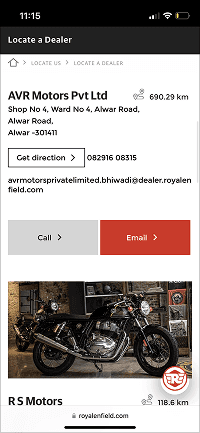


Existing designs (scroll to view)
Royal Enfield Website

Existing IA of the website
Weak brand expression
Royal Enfield carries a meaning; built on originality and innovation. Digital platform’s visual identity felt outdated and disconnected from the legacy it represents.
Missing community building
The audience isn't just new customers, it's enthusiast riders. The website missed the end-to-end engagement journeys, to actually bring the community together.
Broken ecosystem
Riders had no single profile carrying their context across the ecosystem. Every platform treated them like a new visitor instead of a loyal rider the brand already knew.
To understand the behaviour and expectations of a legacy brand user, we conducted interviews of motorcycle enthusiasts, especially riders.
Alongside, we benchmarked leading brands including Harley Davidson, Triumph, BMW Motorrad, KTM, Jawa, Yamaha, TVS to identify best practices and experience gaps across the automotive industry.
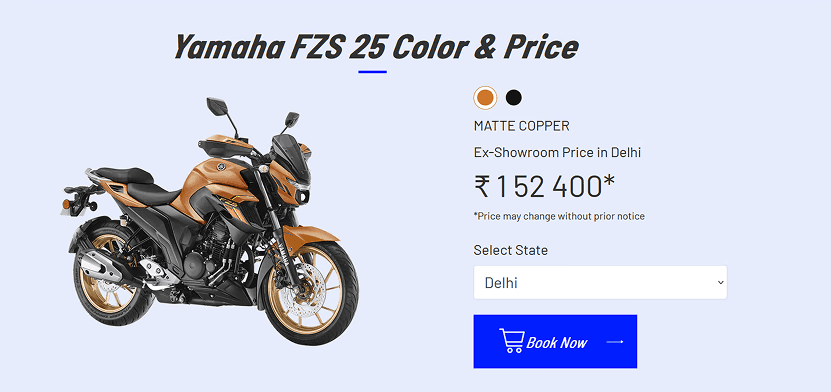

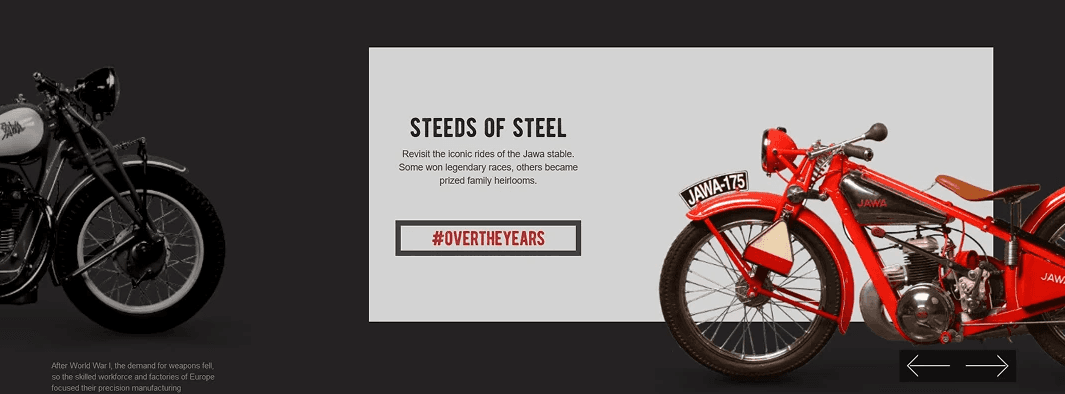
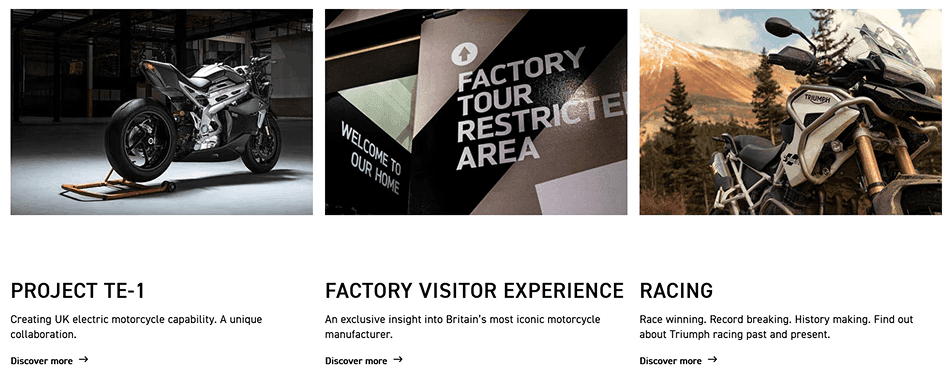
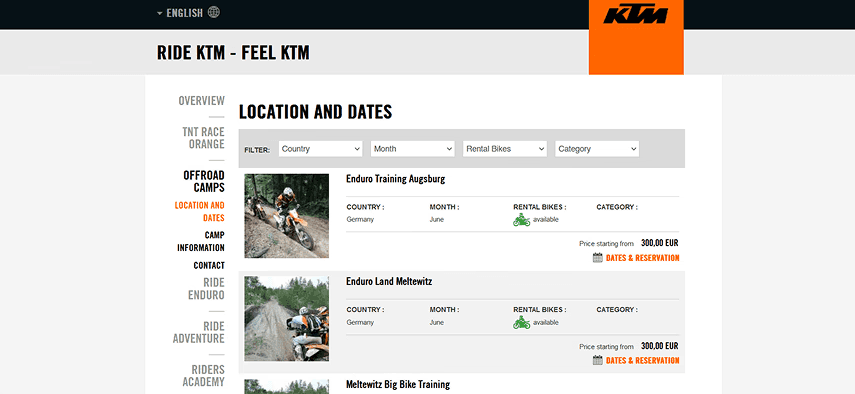
Leading automotive brands in the market (scroll to view)
Price transparency
Interviews surfaced hesitation building up throughout the purchase journey, since the final cost only showed at checkout. They prefer price reveal as they build.
Product visualisation
Riders wanted to see their exact motorcycle, not a static mockup. Very few competitor configurators offer real 3D visualisation, leaving real room to differentiate.
Multiple profiles
Riders across brands were handling separate logins for different platforms in an ecosystem. Almost no competitor unifies identity this way; a gap worth owning.
Fragmented navigation
Fragmented service touch points meant extra clicks just to find the right path. Competitors are trying to solve for this with a well laid out interconnected architecture.
We defined two archetypes we were designing for -

Aspiring rider
Building toward their first Royal Enfield. A young professional from a tier-1 or tier-2 city who sees the bike as more than transport, a reflection of the lifestyle they're working toward.
Bike discovery
Guided configuration
Pricing
Lifestyle

Legacy rider
A Royal Enfield rider for decades. Passionate about customization, and looks after the machine itself. Interested in a community of like minded riders.
Full customization
Loyalty
Real-time updates
Community
Rebuild the digital ecosystem to match its legacy. Journeys that carry riders from discovery to ownership to the Royal Enfield community.
Note
Designing for such brand means working with multiple stakeholders and teams,
each with their own vision and requirements
for the same live ecosystem.
The approach has been to deliver what’s asked, along with a stronger recommendation. This kept stakeholder trust intact while still moving design in the right direction.
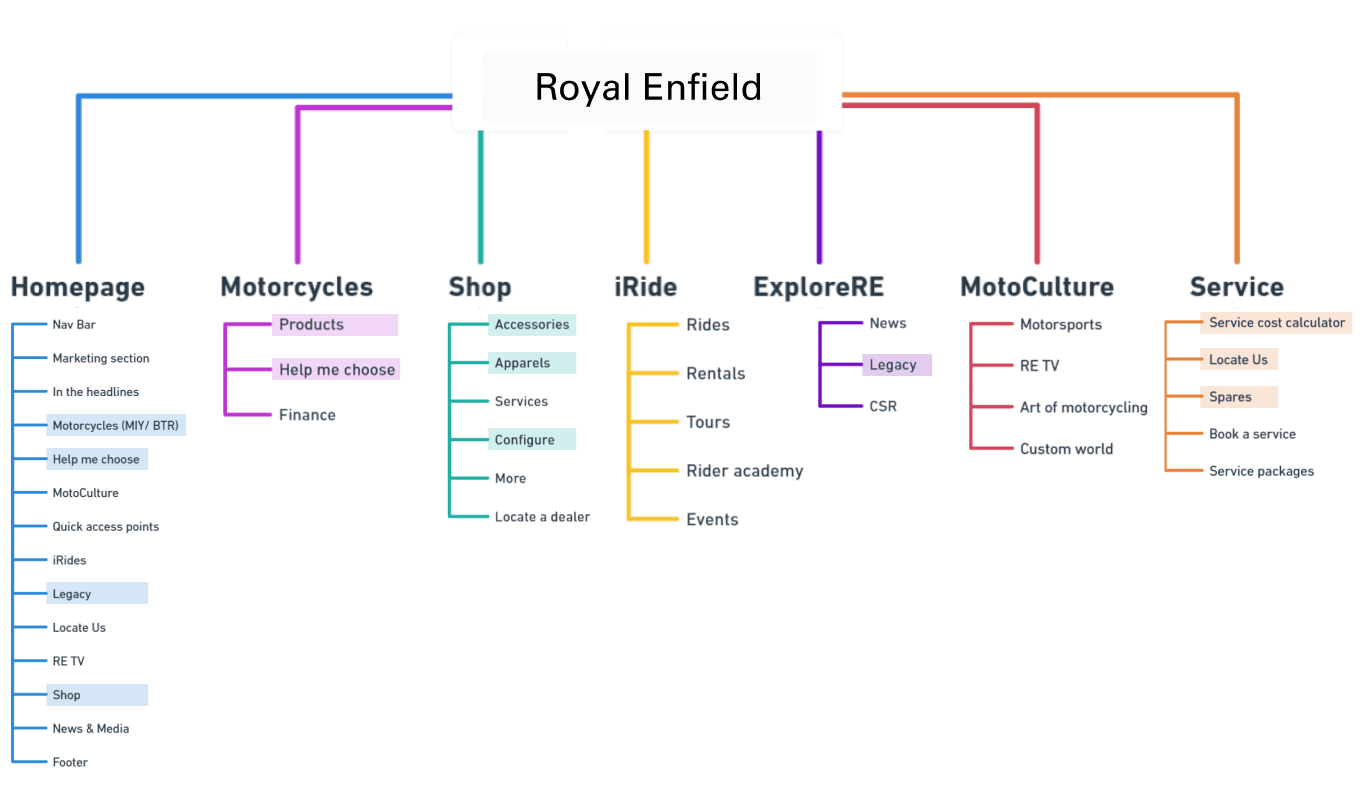
(Revised Architecture)
‘Final’ information architecture
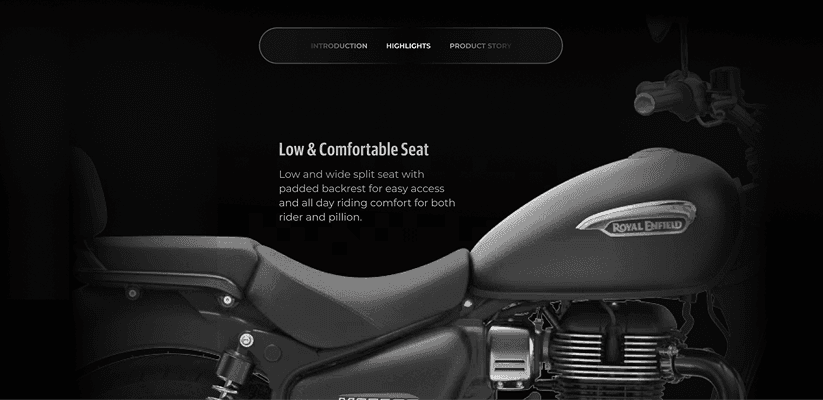


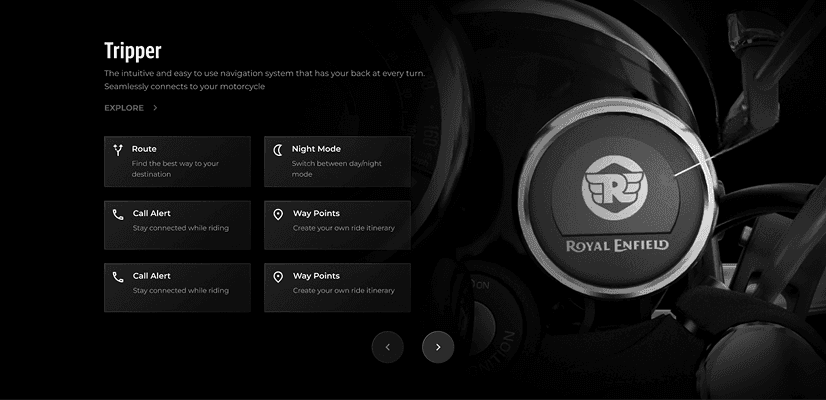
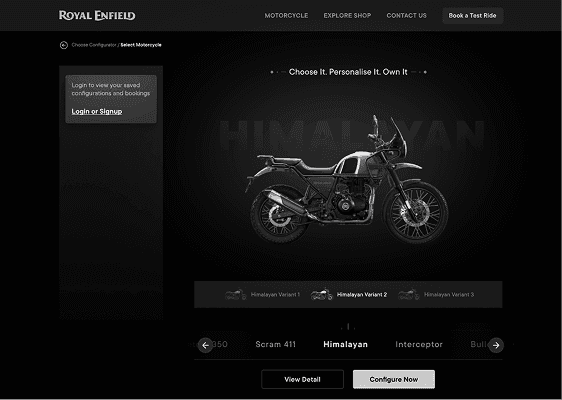


Wireframes (scroll to view)

Stylescape (scroll to view)
(Design Decisions)
Royal Enfield’s Digital Ecosystem
Structured homepage to discover the most suited motorcycle
Challenge
The existing homepage functioned as a catalog, a set of marketing banners with no story tying them together. For a legacy brand, that fell short of what a first impression needed to do.
No narrative hook to build curiosity in someone discovering a motorcycle suited for them
No sense of adventure or lifestyle, despite that being core to the brand's identity
No connection for legacy riders to community, rides, or tours they could be part of
Solution
In such competitive industry, the homepage needed to do digitally what a Royal Enfield showroom already does in person. The approach followed a 3-10-30 second structure: 3 seconds to hook attention, 10 to build clarity on the brand, and 30 to turn interest into a personalised discovery journey.
An immersive scroll behaviour built purely to create curiosity, not to just sell
Layered content designed to spark initial interest and communicate value quickly, without overwhelming
Personalised discovery journeys built to drive deeper exploration and generate leads
Help me discover journey, community rides and tours, dealer locator, and upsells across apparel and accessories, woven directly into the homepage
Once live, the redesigned homepage moved the numbers it was built for -
↑ 25-40%
Scroll depth
↑ 25-45%
Pages per session
↑ 35-45%
Average session time
↓ 20-40%
Drop offs
Structured homepage to discover the most suited motorcycle
Product detail page built for all 3 stages - Shop, Buy & Own
Challenge
By the time a user reaches the product page, curiosity is already build around the product. The existing PDP was still trying to position the brand whereas the need was to reduce uncertainty and convert the user. Or at least generate a lead.
Content still spoke in brand language when the user was looking for solutions solving their needs, technical detail, comparison, and suitability.
Heavy automotive jargon instead of copy oriented around what the user actually needed to decide
No visible way to compare or understand post-purchase benefits before committing
Solution
The new PDP was built around the three real stages of this journey. Shop, where the user discovers, compares, and books a test ride before deciding. Buy, where friction needs to disappear, with multiple ways to complete the purchase online or through a dealer. Own, where the brand's loyalty actually lives, through the connected app, community rides, and service tracking.
A narrative-led layout with free scroll navigation lifting scroll depth up to 60%
Clear, frequent CTAs for booking a test ride placed at peak confidence moments, driving test drive lead gen up to 40%
Cross-sells into accessories and the configurator without forcing navigation, pushing pages per session up to 55%
Premium 3D visuals and transparent pricing, cutting drop-offs by 30%
User need oriented copy to grab attention without automotive jargon, lifting average session time by 35%
Product detail page built for all 3 stages - Shop, Buy & Own
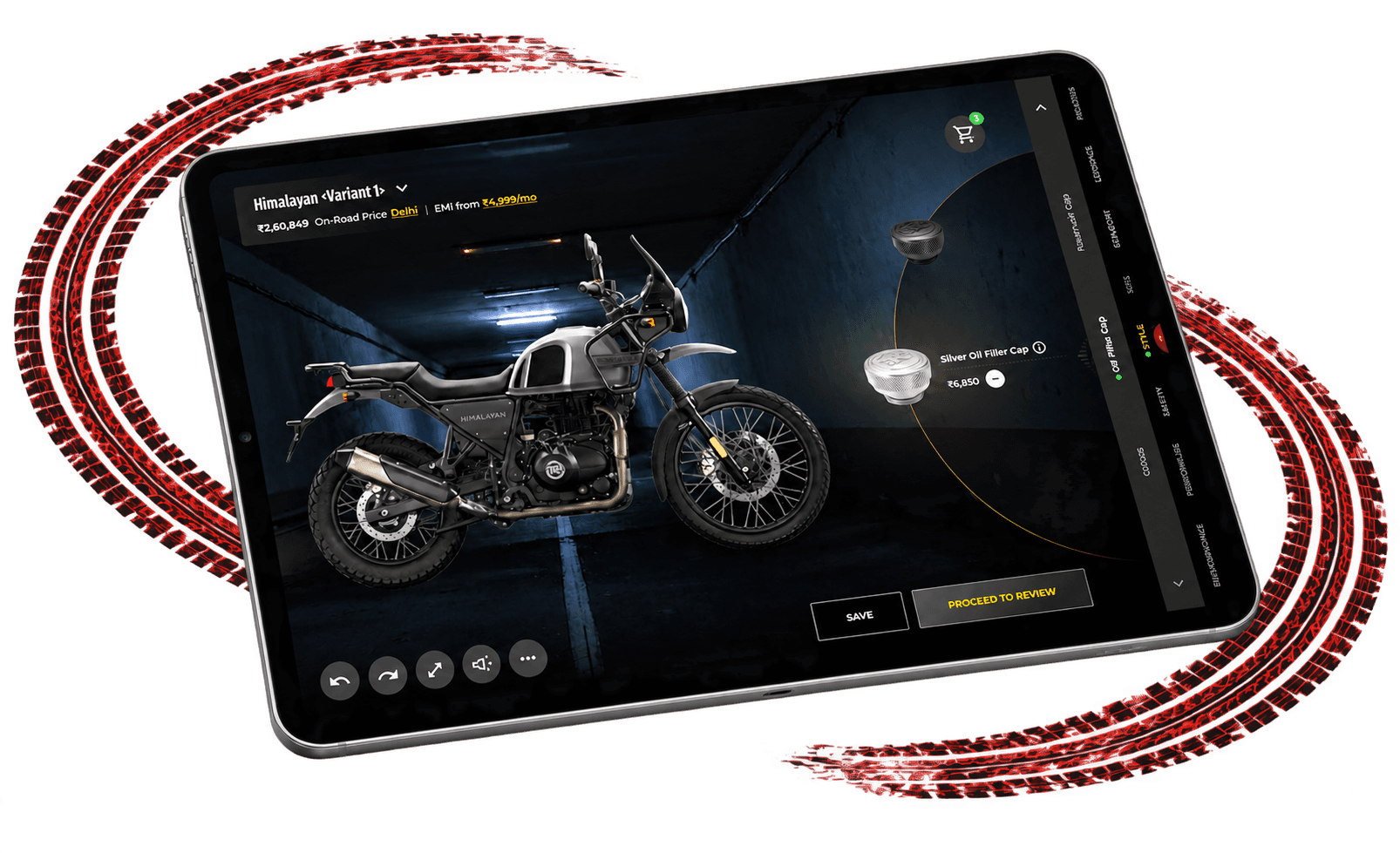
Immersive 3D Configurator
Challenge
A configurator existed but riders rarely used it. Long load times, flat visualisation, and missing immersive experience wasn’t worth spending time in. The journey was broken and lacked trust building around a digital purchase.
Purchase decisions mostly depended on the dealership visit
Dealers received vague leads from website without any sense of what the buyer actually desired
Accessory upselling happened too late in the discovery and purchase journey
No end-to-end journey, leaving generated leads hanging with no linear conversion point
Solution
The configurator was reimagined as an immersive experience built to be an industry differentiator, giving prospective buyers a way to actually picture their dream motorcycle before ever visiting a showroom. The journey lets users build a custom model around real-time accessory choices and book it directly, available across web and app, on desktop, tablet, and mobile, in both portrait and landscape.
A research-driven, end-to-end journey covering booking, live tracking, and accessories access in one continuous flow
Intuitive category navigation structured around real user behaviour, making exploration predictable and decisions clearer increased accessory upselling up 125%
Real-time on-road pricing and feedback at every step, keeping the journey transparent and friction low
3D renders with a full 360° view of accessories, colours, and parts, which lifted engagement time on the configurator by 280%
Immersive 3D Configurator
Validation
Moderated UAT interviews were conducted with dealers and customers at Bangalore & Gurgaon showroom to see how MiY held up under real use -
Customer’s POV:
“What I like most is that each bike has a unique background, like different visuals for the Himalayan and GT motorcycles. This enhances the mood and overall experience.”
“The whole configurator idea is really cool, and the 3D motorcycle is amazing. It really helped me picture exactly how my motorcycle would look.”
“Loved the customization options! It felt like building my own unique motorcycle."
“I liked it, I have seen something like this for the first time, seems pretty convenient to me, easy to navigate.
Dealer’s POV:
“The experience has been excellent. Customers are very excited to use the iPad and customise their motorcycle.”
“Customers configure their bikes before visiting the showroom, making this configurator even more convenient for them.”
“MiY gives us a great advantage by showcasing all models, colours, and accessories in one place, even without the motorcycle in the showroom, helping customers visualize their configuration.”
“Sales has increased by 10-15% as it's easier to convert customers on these features when a specific accessory isn't physically available in our showroom.”
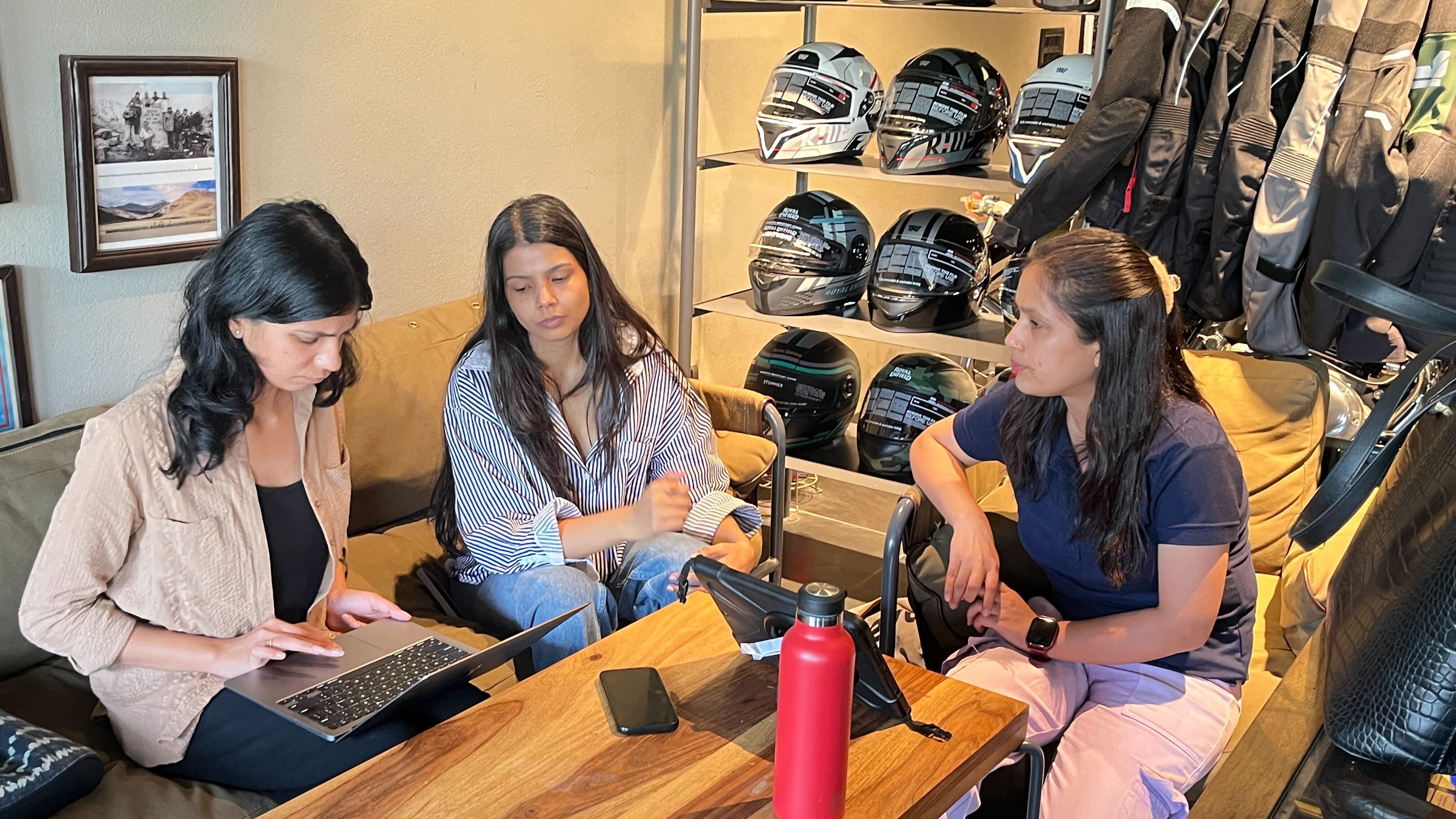


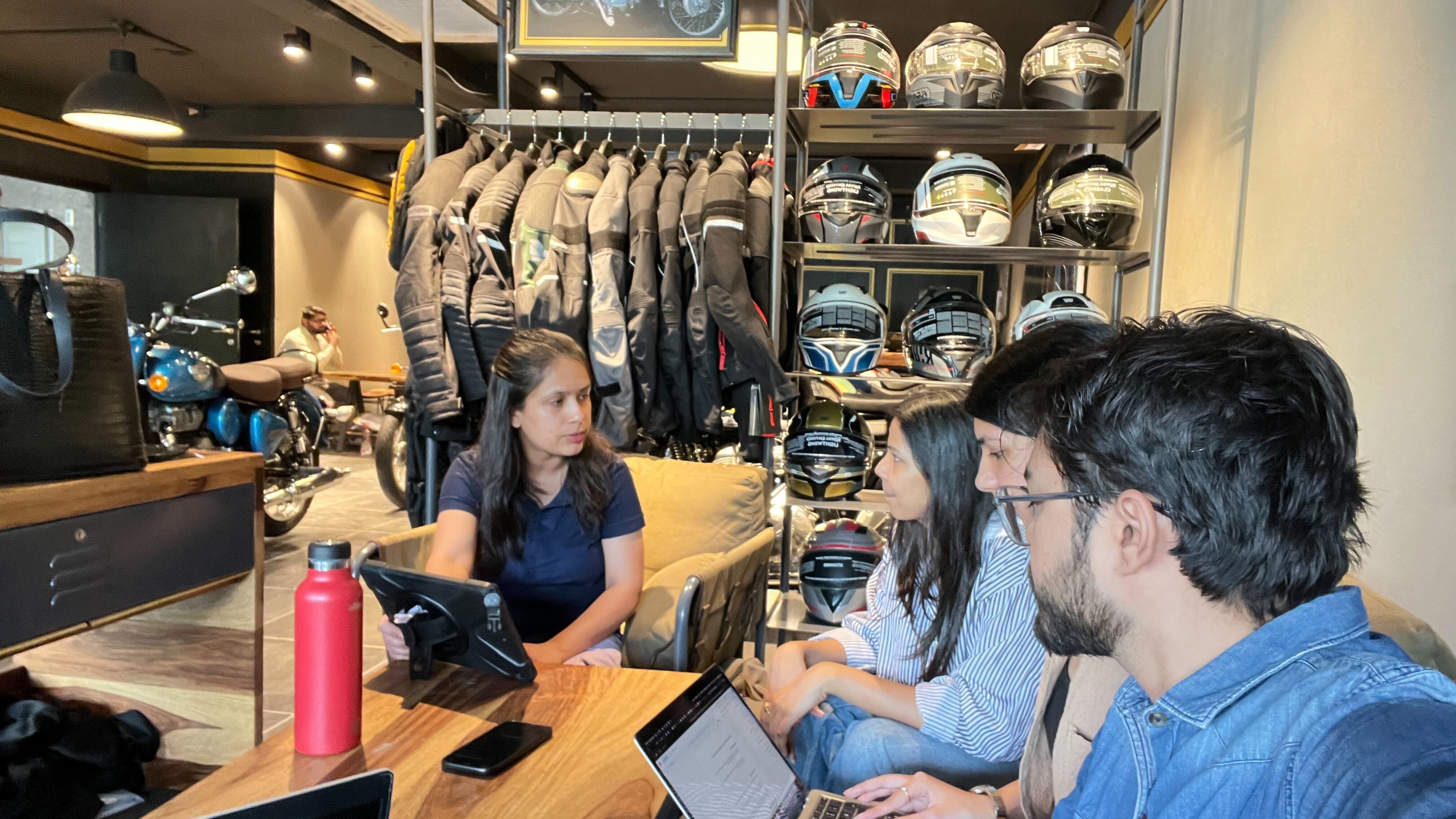


In person and telephonic UATs
Shown above are live and public. The rest of this engagement remains under NDA with Onething Design. Happy to walk through more of it, just reach out.
(What Next?)
Impact & next steps
Phase 1 is live, and the numbers reflect it -
3x
Increase in Daily Active users
2.7x
More time spent on configurator
125%
increase in online sales
Phase 2 & 3 are fully designed and currently in production, carrying the same direction forward across the remaining modules of the ecosystem.
Phase 4, Royal Enfield 2.0, is the next shift. AI is changing how riders discover motorcycles altogether, landing directly on product pages and configurators with an intend of purchase. Meeting that shift means moving beyond SEO alone toward a combined SEO, AIO, and GEO approach, layered onto the existing ecosystem rather than a full rebuild.
(Reflection)
What I learned
Designing for a legacy brand
Working on an automotive legacy brand taught me that not every design decision needs to follow a current trend. The real challenge is understanding which UX pattern solves for the customer base & which are merely trends.
Product Strategy
Working on a retainer taught me that design isn't always linear. Requirements shift, priorities change, and the “ideal” UX flow often had to be revisited. I learned to work in agile sprints instead of waiting for a clean linear process that a project like this was never going to give me.
Mentoring
Two years in, I found myself on the other side of onboarding, bringing in interns & fresh designers, walking them through the brand's design history, and helping them hold onto consistency across a system that had grown a lot bigger than any single person's memory of it.